
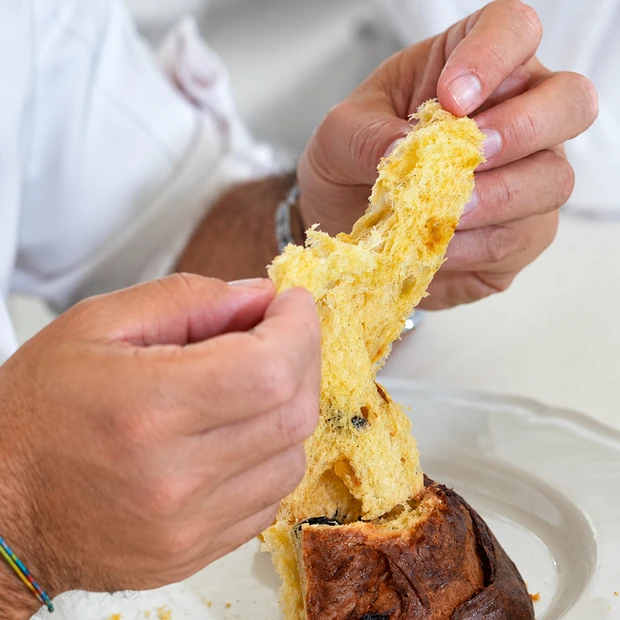
By October, panettone is already in production in Italian bakeries. It reaches the counter in December, but the work that decides how good it will be happens now.
A large leavened cake goes through several stages, each with its own rules and its own margin for error. Anyone who produces it knows the pattern: a tired dough cannot be rescued in the oven, and an unstable glaze shows up at the first slice. It is worth looking at the stages one by one, to see what each of them decides.
Stage 1. The dough: where the structure is built
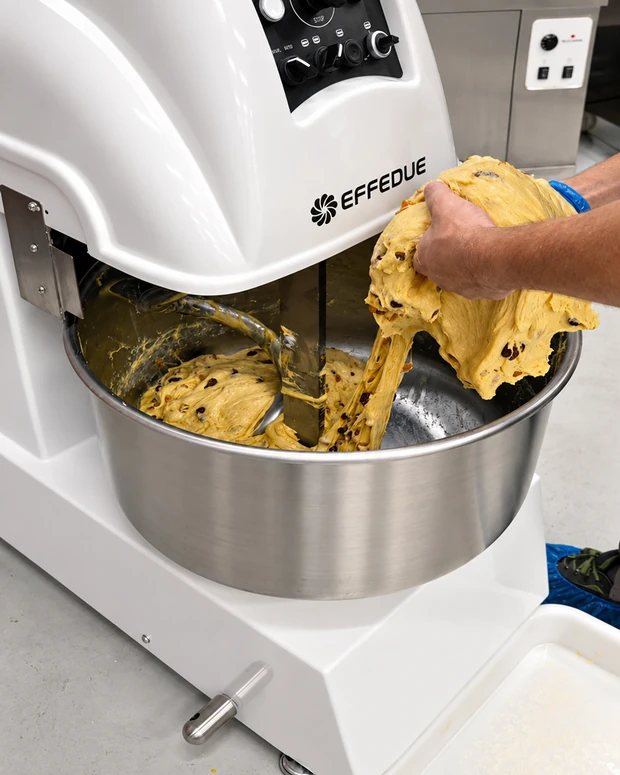
Mixing panettone is a long, intensive process. It builds the gluten network that has to hold the gases of fermentation and carry butter, eggs and sugar without collapsing.
Two things push it to the limit. The first is duration: the longer the mix runs, the more heat the dough picks up from friction, and the final dough temperature is what holds gluten development and structure together. The second is the richness of the dough itself, which makes every step more demanding for the machine and for whoever is running it.
This is the stage with the least room for recovery: what is not built here cannot be corrected later.
Read more: the reference temperatures, where the heat comes from and how to keep it under control in [Mixing panettone: final dough temperature, gluten development, strong flours].
Stage 2. Glaze and creams: where the finish is decided
The first thing you see of a panettone is its surface. The glaze — egg white, sugar, almond flour — is a whipped preparation, and like any whipped preparation it depends on how much air it takes in and how stable it stays until baking.
It is a different kind of work from mixing the dough: the tool, the speed and the type of control all change. The same goes for the creams and fillings that come with the season.
Here the result is measured in texture and hold: a glaze that behaves the same way from the first piece to the last.
Stage 3. Baking: where the work is set
Baking does not correct. It sets. Whatever goes into the oven comes out with the structure it already had, and the oven decides how that structure dries, colours and holds.
For large leavened cakes, consistency of heat and how it is distributed are what count, because a seasonal production means repeated bakes over weeks, with the same result expected every cycle.
Why the three stages have to talk to each other
The three stages are often run as separate compartments: one person mixes, another whips, another bakes. In practice they are connected.
A dough that comes out too warm reaches the oven with a weaker structure, and the oven cannot make up for it. An unstable glaze behaves differently under heat. Consistency in the finished product comes from consistency in every step before it.
That is why, in our group, the brands covering different stages share the same direction: Effedue on mixing, Starmix on glaze and creams, Logiudice on baking artisan leavened products. Different technologies, one single goal.
Try before you decide
The most reliable way to understand how a machine behaves on your own production is to run your own dough through it.
WAICO LAB in Isola Vicentina is the group’s main facility: both machines and ovens can be tested here, which means the whole chain behind a large leavened cake. In Arcole the lab covers ovens and Logiudice mixers, in Pesaro the Italforni ovens.
At all three you work with your own recipes and your own production parameters, alongside our technical team. The trial is free, by appointment.
Book your trial: waicogroup.com/waico-lab
FAQ
What are the stages of panettone production?
Panettone goes through three main stages: mixing, which builds the structure; the preparation of glaze and creams, which defines the finish; and baking, which sets the result. Each stage decides something the following ones cannot correct.
When does panettone production start?
Production gets under way in autumn, months before the December sales period. September is typically when the bakery organises itself; October and November are the production months.
Why does dough temperature matter so much for panettone?
Because it holds gluten development and structure together. A dough that comes out too warm reaches fermentation and baking with a weaker gluten network, and baking cannot compensate for it.
Can the machines be tested before buying?
Yes. At the WAICO labs you can test machines and ovens with your own doughs and your own production parameters, alongside the technical team. The trial is free and can be booked through the website.